Showing posts with label review: books. Show all posts

Friday, July 16, 2010

Komi Cap, KnitPicks Palette, and World Cup thoughts


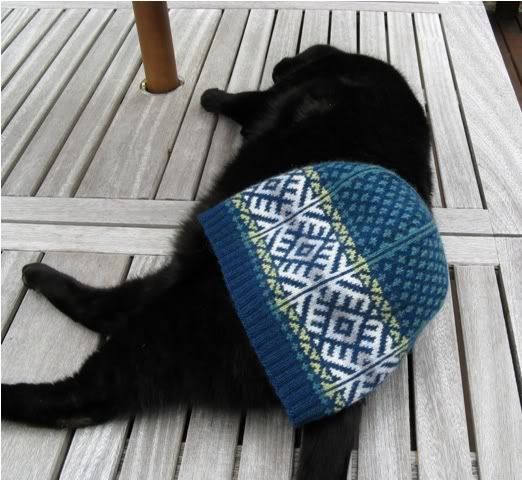
Here we have a Komi cap knit during the World Cup, started after the USMNT went home. (If you enjoyed watching the US team then click on that link, you will love it.) I can't knit when they're playing, I'm either sitting and too nervous to do anything productive (this is how I behave when others are in the room, like I'm actually sane, hee!) or pacing around and talking/pleading/crying at the TV and rending garments (that's me all alone when others had the good sense to be asleep). I only wish Charlie Davies had been healthy, we needed him badly and I'm certain we would've won more with him on the pitch. Did you know not a single USMNT striker scored a goal in this World Cup? Charlie would've scored, just sayin.' Still super proud of our boys for winning their group, but they expected to go even further so the 2-1 loss to Ghana was heartbreaking. It's a good sign we felt disappointment instead of simply being elated to make it out of the group stage.

I was cheering on Spain in the World Cup final, partly because USA beat Spain 2-0 in the Confederations Cup last year, and it's pretty cool to know our boys can shut out the best national team in the world. Iker Casillas was in goal, which made it even sweeter. I love and respect the guy, but you want to score on the best, right? ¡Viva España! They deserved to win the World Cup, Iker deserved his Golden Glove award, I'm happy for them.

WHAT, this is a knitting blog? I mean, when I actually get around to blogging. All right, back to knitting. It's 4 years until the next World Cup, you can be thankful I don't blog about the Sounders every week. (DID YOU SEE the Nyassi -> Montero -> Levesque's head goal in the 89th minute last night? To win the game 1-0?! And Kasey Keller showed once again why he is Man of the Match FOR LIFE.)

OMG NO MORE SOCCER STOP TALKING ABOUT SOCCER


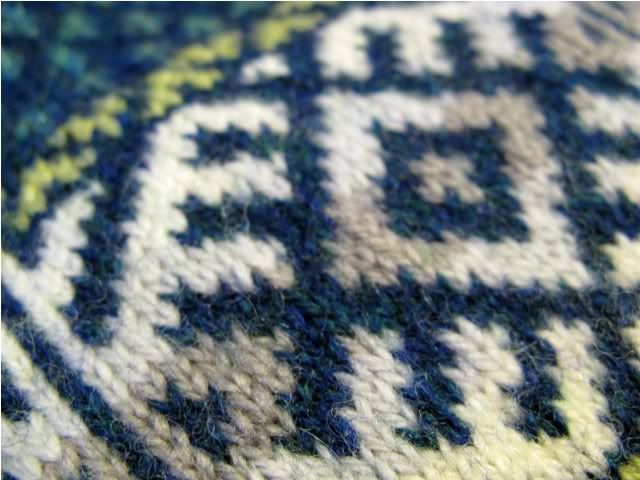
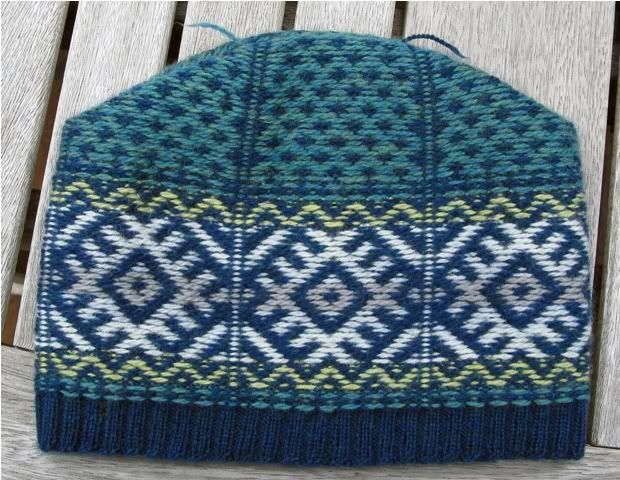
For those who enjoy seeing colorwork inside-out
(It gives me an idea of how the same patt would look as light
on dark or vice-versa, depending on your original colors)


I'm not sure who will get this. My older brother is still wearing a Scandinavian hat I made for him several years ago. When he saw me working on this Komi cap last week he asked if it was for him but it might be too small, he has a gigantic head. I know he's wearing the old hat because he actually had it on during his visit, despite the July heat. Weird brother.
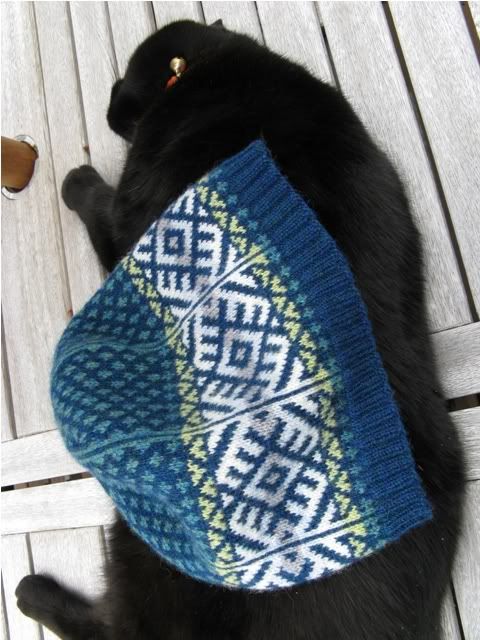

I took a dozen photos of the cap draped on Rocky, adjusting and
moving the cap around, he didn't even flinch. Whatta lump.
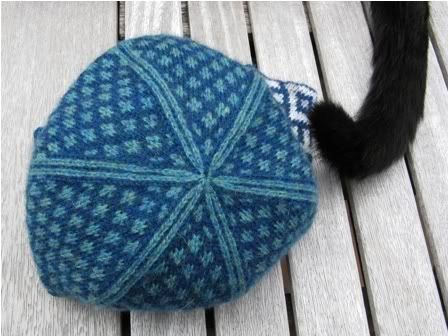


top o' the cap
Rocky's tail makes this look like part of the photo above it, cute


The pattern is found in the 2009 revised edition of Mostly Mittens: Ethnic Knitting Designs from Russia by Charlene Schurch. Several years ago I borrowed earlier editions of this book from the library and knit some great mittens but never got around to buying the book before the 2001 edition (titled Knitting Marvelous Mittens) went out of print and the price jumped. Then sad news was passed around: the book would never see a new printing, all the original plates were lost or destroyed, everything would have to be reknit, etc. I have no idea how much of that was true, but the book is available again so it doesn't matter. Martingale & Co might do a better job of keeping it in print, but I wasn't about to let this fine collection of patterns slip through my fingers again. KnitPicks helped out with their 40% off book sale too.

I haven't looked through the two earlier editions in a few years but I think the main difference is that a couple sock patterns were dropped and some hat patterns were added. The socks caused problems for some knitters, they couldn't pull the socks over their heels thanks to the tightly knit colorwork, so maybe complaints about that had something to do with the change.

The yarn is KnitPicks Palette (100% Peruvian fingering weight wool) knit at 10 sts/in and 11 rounds/inch on size 0 needles. Each round is 204 sts, which almost put me off the pattern but I decided to go for it and it still knit up fairly quickly so it's not a big deal. Colorwork always seems to go fast and hats are small projects.

KnitPicks Palette colors used (in order of appearance), less than 50g each:

Marine Heather
Tidepool Heather
Green Tea Heather
Cream
Mist
Silver


The subtle difference between cream and mist doesn't show up in these photos, the lighting washes out the light grey (mist), but there really are three colors used in the background of the main patt.

The Green Tea Heather looks different in the skein, I don't like how it looks so yellow in the hat, I expected something bright but greener. Oh well, I should've swatched all the colors together instead of placing the skeins in a pile.

This was my first time working with Palette and I'll definitely order more. It's very affordable ($1.99 for solids, $2.19 for heathers) and has a good selection of colors. The main thing I don't like about it is the same thing I don't like about most wool yarns: it makes my wrists itch. I'm envious of people who aren't sensitive to wool. I soaked the hat with Pantene hair conditioner and it seems pretty soft now, I might be able to wear it on my head.

Another problem with Palette is how the colors display on the KnitPicks website. Unfortunately Palette color cards are no longer available so you'll have to guess based on what you can see on your monitor. If you can afford to buy a few extra balls in the color range you're aiming for then you might be happy to have some options when your order arrives. Be prepared to place another order or arrange for an exchange if the blue that looks perfect on the website is completely wrong when you have it in your hands.

What's next? Mike needs felted slippers, how very exciting! zzzzzzzzzzzzzzz.

Friday, January 12, 2007

Book Review: Crazy Heels & Toes by Mary Ann Beattie

I've been hearing murmurings about this book for a few years and was curious about the mysterious "no wrap, no gap" short row heel. I enjoy learning new techniques so I told my parents about it and they gave it to me for Christmas.

Here is the "no wrap, no gap" short row heel:


both sides
this is a scan so things look a little smooshed, but you get the idea

Is it less fiddly than wrapping? Not really, it's pretty much the same, it still involves picking something up (a purl bump instead of a wrap) and working it together with another stitch, which I find tedious, especially at a small gauge on size 0 needles. Are there any gaps? Nope, it lives up to the name, there are no gaps, even when I press my finger against the inside of the sock and distort the fabric to try and make holes appear. This is a great short row heel, and there's even a variation that includes small gussets on the sides for those who need a little extra room.

I still prefer heel flaps with gussets. The thing is, I really enjoy knitting heel flaps and then turning the heel and picking up gusset sts. I find it soothing and clean and orderly, which is exactly what some people love about short row heels. Isn't that funny? I haven't yet found a short row heel that will permanently lure me away from heel flaps.

The short row heel in Crazy Toes and Heels is actually a very small part of the book, the star of the show is a different heel, which looks a lot like a heel flap heel, but you don't actually knit a heel flap or pick up gusset sts. I might as well try that next, even though it contradicts what I said in the previous paragraph. There's also a lot of information about knitting two socks at the same time on two circular needles, different toes, casting on, casting off, and she walks you through an afterthought heel. Instructions are written with the two circular technique in mind, but it isn't necessary to knit socks that way, you can still follow along with your magic loop or dpns.

If you've read other reviews about Crazy Toes and Heels you already know it's chaotic, especially if you are flipping through it. The information is densely packed on the pages and it's very wordy, much like this review. Would I want all knitting books to look like this? Absolutely not. It breaks ALL design and editing rules, and then some you never thought of. It's easy to understand why it makes some people want to tear their hair out. Right now it's a jumble of information, it'd be an astounding book if a sharp editor (with heaps of knitting experience) and a layout designer could get their hands on the content.

A review online claims this book is not for blind followers, but I disagree. It holds your hand every step of the way, for example there are photos that show the before and after of slipping a stitch. It often seems an entire page could've (should've?) been clearly distilled down to 1/4 page or maybe even a few sentences. Beattie writes in her introduction, "Once you actually learn the cast-on and increase movements, you'll fly right through the 26 steps in a flash! For example, the 12 steps of one toe cast on loop takes me about 5 seconds to actually maneuver." Do you need one loop broken down into 12 steps? If so, this book was written for you.

I'd rather show a new sock knitter clear and concise directions on how to knit a sock first. There are some great tutorials online, found over at the Socknitters site. If the online tutorials aren't much help then I think you'd be better off watching an instructional video or taking a class at your LYS. You can buy this book if you're curious about the Queen Kahuna techniques after you understand how socks are constructed. However, I've seen reviews posted on the Socknitters list from experienced sock knitters who couldn't decipher the instructions, the information is presented in a way that doesn't make sense to them, so knowledge of sock knitting isn't a guarantee you'll be able to follow the book.

Here's my recommendation on Crazy Toes and Heels: It's a good book to put on your next birthday/holiday wish list, but only if you enjoy knitting socks. Buy it if you don't want to wait that long. If you're disappointed or overwhelmed it'd be easy to sell, simply post a sale/trade note on the Socknitters list or Knitswap and you'll receive multiple bites. If there wasn't anything new then I'd say give it a pass, but the innovative heels and toes are worth learning if you're into trying new things.

The book is only available for purchase from the author, via her website at http://www.queenkahuna-creations.com. Looking over the website will give you some idea of the book's layout and writing style, consider it fair warning. The following URL is a good place to start:
http://www.queenkahuna-creations.com/crazytoesandheelsbook.html. Download the pdf on that page for the Aloha cast-on for another sample.

Yeah, there are a lot of quotation marks around random words in the book too, in just about every sentence. In fact that is my #1 complaint about the book: it would be improved beyond measure if every " in the book was deleted.


That's the official end of my review, but there's something else I want to talk about. Before I got the book I thought it odd that nobody wanted to talk about how these heels and toes were done, knitters sure love to share information. Now I understand why, it's the unique copyright notice. I won't reprint it here, but reading it will grant you a one-way ticket to Guilt Trip City.

I'm not a lawyer but from what I understand the actual techniques can not be copyrighted. They can be patented, which is different. For example, Girl from Auntie showed us an old patent granted for a heel turn. I would certainly be breaking copyright if I scanned the Crazy Toes and Heels pages and posted them here, which I would never do, but if I explained how the heels were done, in my own words and with my own photos, that is not breaking copyright. (Again, me = not a lawyer.) But there are a few reasons why I won't do that.

1) If you've ever written an indepth tutorial you know it takes a stupid amount of time, what with taking the photos, editing photos, writing text, editing text, and putting it all together. Eventually someone will write their own version of these instructions and post them for free on the internet, it's inevitable -- maybe someone has and I missed it. I don't want to be that person.

2) People will print the tutorial and share it with their knitting friends and classes, because that is exactly what people do with my other tutorials. Some people are considerate enough to ask, and I always say yes, but I imagine for everyone who asks there are a lot more who just download and print.

3) I feel weird about #2, because these Queen Kahuna techniques are genuinely innovative and complex, it's not as simple as knitting a sock on 2 circulars or using a single circular with loops on the sides. Detailed information on the QK techniques is already out there for people who want it, in the form of Crazy Toes and Heels. It'll cost money but I think the author deserves some compensation for sharing her brand-new techniques with everyone. And you know all the money goes directly to the author, it's not being gobbled up by a publishing house. (I heard a rumor that another author actually owed money to her publishing company after her sock book was published.) I don't believe Beattie is getting rich off this book (and if she is, good for her), because she probably spends a lot of money on printer hardware, color ink, paper, and bindings. I also have to consider the hundreds of hours she spent writing the book and editing photos, plus the time she still invests printing, assembling, and binding every book that leaves her house.

So, what do you think? I'm curious how others feel about these new techniques only being available to you if you buy a book. I can see both sides of the situation. For example, despite my feelings expressed in #3 above, I'd find it silly if people said "Oh no, you can't tell someone how to do applied i-cord, they have to buy EZ's book or video and learn that way." EZ came up with applied i-cord and all the numerous variations, she published those techniques, and then the information was shared and it spread. How is this different? I'm not sure it is.

Where do you draw the line? Showing a small number of friends the techniques? If your knitting club wanted you to share how to do the Kahuna heels would you teach a free informal lesson for everyone, maybe hand out instructions you wrote yourself? Teach the techniques in a class at your LYS, where the students paid money to learn? Post the instructions online (using your own words and photos)? The book's copyright notice informs us that the author prefers you not do any of these things, she expects you to refer people to her website so they can order their own copy of the book. Does that make you less interested in buying her book or bothering with the techniques, knowing the author doesn't want you sharing the information?

Where would knitting be if people were shamed into never teaching what they knew to other knitters? It wasn't that long ago when knitting patterns/techniques/instructions weren't written down, they were almost exclusively shared verbally. But in 2007 is it unrealistic for a knitter to expect compensation for her innovations? Or should we be content to just write the book -- if we have the time and resources -- and hope some people buy it before it's all posted online?

Just some stuff to think about, and I'd like to hear more opinions. Via email is fine if you don't want to leave a public comment: andrade at az dot com.

Tuesday, June 06, 2006

Baby items and my publishing debut

I thought this baby sweater would be done by now, the last stitch was knit a few weeks ago, but it's still waiting on a zipper. That'll have to be ordered online, I went to four fabric stores and nobody had a separating zipper in the right color.

The front:


I love the pointy elf hood

The back:


It's pinned together where the zipper will go. I'll probably seam the hood and stop the zipper at the neck so the baby won't have his/her head pressed against a hard zipper. Of course the colors look much better in person (more jewel like and vibrant), my digital camera kungfu is not the best.

Some knitters praise Plymouth Encore over Lion Brand Wool-Ease (both are 25% wool, 75% acrylic and OK to machine wash/dry) but they don't feel all that different to me. It still feels like knitting with acrylic, though not really gross acrylic. Encore is available in better colors, which is a definite plus, so for that alone I'd be more likely to use Encore again -- if I could buy it in local yarn shops. Maybe Encore wears and washes better than Wool-Ease. I'd much rather use a nice superwash wool but this Encore was so cheap, the jewel blue color is fantastic, and it'll survive multiple trips through the dryer.

Pattern is free, located here: http://knitting.about.com/library/blbabyswe4.htm
I don't recall finding any errors in the pattern, it's pretty straight-forward.


Right now I'm working on a bootie using leftover Lorna's Laces sock yarn, here's the first one in this pair:


I'm knitting these on size 0 needles so they're smaller than the size 1 booties posted last month. The leg is also a lot longer (40 rounds) so they can be folded over or left up to keep the leg warm.


I've been published! Apparently they'll give a book deal to anyone nowadays. I'm kidding, I didn't write a book, but my website made it into one. Some time ago Judy Brown asked permission to include my website address in her book so I said sure and promptly forgot about it. As a generous thank you (which I wasn't at all expecting) she sent the final product, a knitting journal titled Knitting Notes.


One thing I really like is the spiral binding, which makes it easy to cleanly tear out a ruined journal page. The full page size is an advantage over the smaller knitting journals I've seen in book stores. I also like the Canadian flavor, because I have a crush on Canada.

A knitting journal isn't the sort of thing I'd buy myself (I'd be more inclined to make one, I'm cheap) but now that one is in my hands I can see myself using it. I'm trying to decide if I want to start the journal with my current projects or backtrack by entering in data for projects completed years ago. It's nice to have that info in my blog but I can see the advantages of keeping it all in a paper journal as well.

Something Judy wrote struck a chord: "Use [the journal] well and it will be a treasured gift to hand down." She's right, I wish my grandma had kept a knitting/crochet journal, I would've dearly loved to look through it every so often. I have her crochet hooks and knitting needles, but I don't know anything about what she made with them.

Tuesday, January 31, 2006

Starmore, the Early Years


Borrowed from the library: Scandinavian Knitwear (1982), Knitting from the British Islands (1983), Children's Knitting from Many Lands (1984).

In my opinion these three pattern books are not worth the money some shops demand but I'd pay a normal used book price (say, under $12). There are a few sweaters knit in the round (without making use of steeks) but the great majority are worked in pieces, which is a plus or minus depending on your personal preference. Even the hats in Scandinavian Knitwear are knit flat and seamed up.

As for the designs, it's a mixed bag. Check out that Aran dress on the cover: Yikes! Some items look dated, as is expected from patterns published in the early '80s, but there are a few appealing classic pieces in each book and more not-so-appealing classics. YMMV.

You can buy the "Patrington & Withernsea" pattern in Knitting from the British Islands on the Virtual Yarns website (it's been renamed Scalpay in the AS Classics section), as long as you don't mind buying it as a kit. I think it looks better on the website and I suspect the pattern has been updated and improved.

If you're curious but your library doesn't own these three books, ask about interlibrary loan. That reminds me, I should see if it's possible to borrow Pacific Coast Highway on loan.

Birthday gloves: One is done, it's drying inside-out right now so it's not ready for a photo. I just finished the cuff for its mate, looks like they'll be a little late for mom's friend's official birthday next week.

Monday, August 29, 2005

Norwegian Knitting Designs

I found a small OOP treasure at a used bookstore in Fairhaven the other day:


Norwegian Knitting Designs
selected by Annichen Sibbern Bøhn
Published in Oslo, Norway 1975 (©. 1965)

I have a weakness for old knitting books and this is a sweet little book, it appeals to the Norwegian in me and there are a few patterns I plan to use. The written sweater patterns are vague so they are mainly of use to those who already knit traditional Norwegian sweaters with steeks in their sleep. (Actually, if you're skilled enough to knit a sweater from these skimpy instructions then you probably don't need 'em.) The graphs of course can be adapted into any pattern:


Can you see this woman dancing around a sweater or mitten, she makes me smile:


As much as I appreciate the book I can't say it's worth the asking prices on bookfinder.com (so it's not going on my recommended list) but it was certainly worth the $6 I paid.

Saturday, April 16, 2005

Book Review: Knitting Ganseys

Knitting Ganseys by Beth Brown-Reinsel

Knitting Ganseys isn't a standard book of knitting patterns, it's an instructional book. Chapter 1 covers the history of gansey knitting. Chapters 2 through 10 walk you through the process of knitting a small sampler gansey, which teaches traditional techniques such as underarm gussets. Chapter 11 explains how to design your own sweater and Chapter 12 has six gansey patterns ready to knit (3 child, 3 adult). Hundreds of clear black & white photographs back up the text, there's no reason anyone who knows how to knit and purl should feel intimidated by this book.

I borrowed Knitting Ganseys from the library a few years ago and made the sampler sweater:


Let's see if I can find a model for it. Yes!


Babar wonders what he did to deserve an ill-fitting sweater dress


I really like the concept of knitting a small sampler to learn how things fit together before starting an adult sweater. Ripping back is painless when you're working on an item this size. It works up quickly and you don't have to concern yourself with gauge or fitting a recipient while you're learning the traditional techniques. Get your first-timer mistakes out of the way on the practice piece, it makes sense to me.

After you finish the sampler you're ready to knit one of the six patterns included. If none of those sweaters strike your fancy you can work through the chapter on designing your own gansey. Sixteen pages of knit/purl stitch patterns are included to help you chart your dream sweater.


I pounced on Knitting Ganseys when I finally found it in a used bookshop last week. It has valuable information that will never go out of style, adding it to my collection was a no-brainer. Some of the book sellers on Amazon and Bookfinder have the book listed at well over cover price. It can be purchased new from Schoolhouse Press and other online knit shops so don't pay an inflated price.

Wednesday, March 23, 2005

A Magical Knitting Book Review

Yesterday I went to the library to return some DVDs (Horatio Hornblower, fun adventure on the high seas) and borrow a few books. One of those books was A Treasury of Magical Knitting by Cat Bordhi. You might know her from Socks Soar on Two Circular Needles. I flipped through the Magical Knitting book at the LYS last year but nothing in it grabbed my attention. Which is fine, my lack of NEED IT NOW interest makes it an ideal book to borrow from the library and explore at leisure. That way I won't feel like I wasted money on it -- and with a pricetag of $27.00 I reserve the right to be picky.

So I was flipping through the library's copy of Magical Knitting and a photo taken at the top of a waterfall jumped out at me.


Hey, that's right down the street, I can walk there! How did they find that location? It made sense after I was reminded Cat Bordhi lives in Friday Harbor, on San Juan island (a short boat ride away). And I know for certain that's MY waterfall (OK, I don't own it) because a photo on the previous page shows the model standing on the stone bridge next to it.

The San Juan islands are my personal vision of heaven. I happened to be in Friday Harbor last October, here are some photos of the marina:


The sign says "Port of Friday Harbor Marina"


OK, so what do I think of A Treasury of Magical Knitting?

Here is where I ignore the inexplicable fictional story about the discovery of the moebius strip and circular needles. Moving right along...

I'm sure I'll eventually make at least one moebius scarf, I like trying new knitting techniques and the cast on is different/bizarre. It involves a provisional-like cast on with a 47"-60" circular curled up in a coil like a snake -- that makes zero sense, you have to see the pictures in the book.

At first I was thinking oh great, I need to buy a 47" circular just to try this out (because the only 47" circs I own are size 0 and size 000) but Bordhi mentions that the Denise interchangeables are a good fit for her moebius technique. I have a 40" Denise cord (which makes a 48" circ) so hey, I won't have to buy new needles or cords.

The written instructions and photos are very clear, it's obvious that Bordhi taught this technique in numerous workshops before writing the book. All the details have been patiently explained and pitfalls averted because she knows exactly when someone would raise a hand in class and ask, "But what happens if...?" There's even an entire FAQ chapter, which is both clever and helpful.

So what can we make with a moebius? Well, there's scarves, shawls, capes, hats, and felted socks. You'll find felted bags, baskets, bowls, and cat beds in the follow-up book, A Second Treasury of Magical Knitting. The first book has three pages of preview photos for the second book but that's all I know about it, I haven't seen the second book yet. Aside: This is kinda misleading, some people quickly flipping through the first book in a store will see the photos of bags, baskets, bowls, and cat beds and assume the patterns are in the book they're buying. Wrong. I don't believe it was Bordhi's intention to trick people of course, but it's going to annoy some knitters. And we all know how easy it is to annoy knitters. Ha ha ha.

The scarves show off the moebius best because they actually look like moebius strips. The shawls tend to look like they might have been twisted on accident when they were put on (though some do look quite nice), the other objects basically have a twisted cuff or handle so they look like the cuff on the hat is flipped up wrong or yay there's a twist in the handle (eh, you might be more excited than me about that). If you click on the cover photo for Bordhi's second moebius book on Amazon.com you'll see some of the felted items. I doubt I'll ever make one of those things but I see a moebius scarf in my future. I especially like the idea of making a moebius scarf with applied i-cord edging in a contrasting color.

Thursday, January 27, 2005

Casting On

the knitrider asked:
Are there very many cast on methods? all i know is the basic cast on method, and i know there are ways to make the cast on look neater. can you recommend a book that thoroughly explains them, or a site? Or is that Neatby book the best source?


If you're interested in a specific cast on you can try googling the name(s) it is known by, some sites include helpful videos or photos. I have a short list of sites that feature online knitting videos [click here], they all have videos for casting on.

The first book that comes to mind is Monste Stanley's Reader's Digest Knitter's Handbook, which boasts around 30 cast ons. That's overkill to be sure but hey, why not? Most public libraries should have this book in their collection. The writing is dry, like a school text book, but it covers a lot of ground.

Another book your public library should have is Vogue Knitting (not to be confused with the Vogue Knitting magazine), that book explains how to do about a dozen cast ons.

The Knitter's Book of Finishing Techniques by Nancie Wiseman features 7 cast ons and it's worth mentioning because she clearly outlines the benefits and drawbacks of each method.

Neatby's Cool Socks Warm Feet is a great resource for sock knitters, it shows 4 cast on methods (long tail, channel island, provisional crochet, tubular). I do have a complaint about the way this book teaches the kitchener stitch but that's a gripe for another time (if anyone cares to hear it).

How many cast ons do you really need to know? I have no doubt that thousands of knitters know exactly one cast on and their knitting doesn't suffer for it. But it's handy to know something versatile (long tail), something stretchy (twisted german), something firm (cable), something temporary (provisional), and maybe something decorative (picot). And the tubular cast on for K1P1 rib is a thing of beauty. Those are just suggestions, for example there's more than one stretchy cast on and long tail is stretchy enough for a lot of people. There's no reason to memorize everything, that's why I own reference books.

And finally I leave you with a conversation that has never happened before in the history of the Universe:

K: Have you heard of Rent? The musical, you know, Rent?

D: Yeah, Barbra Streisand was in that.

K: No.

D: Oh she was in Lent.

K: She was in Yentl, not Lent. LENT???

D: Oh right.

(at this point we are both cracking up)

K: I am SO putting this in my blog.

Tuesday, November 16, 2004

Book Review: Arans & Celtics

I recently borrowed Arans & Celtics from the library, the latest in the XRX Best of Knitter's magazine series. I noticed a few gems that were missing but maybe they're holding those patterns back for a volume 2.

There was one standout pattern I almost missed because I was so disturbed and distracted by a bobbly sweater ("Bobbled Braids") and quickly turned the page. (Anything with bobble in the name is a good clue there are way too many of the beasties cluttering up the design.) I noticed the small picture of the "Refined Aran" rear view and backed up a page to see the full page photograph. It's a winner all right, and I'm not normally impressed by vests. I love the gauge (7 sts/in) and the cables are both delicate and intricate without being too busy. If I were to knit anything from this book "Refined Aran" would be my first choice. The "Irish Moss" cardigan is also lovely.

Would I buy the book? At $19.95 it isn't a bad price but I have so many projects lined up I can't justify buying it right now. I'm thankful my library has it and for now that's good enough for me.

Monday, April 12, 2004

Book reviews

Yesterday I checked out 5 books from the library:

Vogue Knitting Socks: There is one gem of a pattern that has a gauge I like (9 sts/in) and a really cool 4 color pattern -- the Zig Zag socks. I wonder if the ragg yarn would look good knit up like this? I'd have to dye some of it 4 different colors and knit a swatch to be sure but I think it'd work and it wouldn't cost anything, I already have the yarn and dyes. I could do something different and make the four colors red, orange, yellow, and purple (instead of my familiar blues/greens). But I liiiiiiike blue and green.

Knitting Around the World, from Threads: I've checked this out before but haven't seen it on the shelf in quite a while so I brought it home again. It's OOP unfortunately. The only low point is an article containing spectacularly UGLY faux Bohus Stickning knitting patterns! However it IS amusing to see someone try to interpret the Swedish Bohus designs, years before Poems of Color was available. The rest of the book is very educational, it contains articles on Shetland lace knitting, Fair Isle tams, seamless argyles, Swedish tvaandsstickning, arans, and more.

Men in Knits: This is new to the library. There are some good patterns but ho-hum, nothing that screams KNIT ME RIGHT NOW. There's no obvious reason to buy it for my bookshelf. The author devotes several pages to the psychology of men and handknit sweaters and how to go about making a sweater that a man will like enough to wear. Kinda strange. It's almost obsessive with all the charts and questions the author expects us to unload on the sweater recipient but if you follow all her instructions you'll probably make something that the recipient will wear. Apparently this is a problem for a lot of knitters, who knew men were so fickle?

Knitting from the Top (Barbara Walker): Someone lost this a couple years ago and the library finally replaced it. It's a Barbara Walker book, of course it's brilliant. I don't need to own it though, I'm content with knowing it's available from the library if I need it for some reason. Well, as long as nobody LOSES it again. If I ever decide to knit pants this is the book to check out.

A Fourth Treasury of Knitting Patterns (Barbara Walker): I need to own all 4 Treasury books, they're worth their weight in gold. I see some reversible stitch patterns that I'd like to turn into a scarf for my mom, to match the dark brown merino gloves I knit her last month. My favorite is Hearts of Oak (p. 194-195), that is very cool and the back looks almost as good as the front (which is important for a two-sided item like a scarf). Floral Mesh (p. 218) is also appealing.